
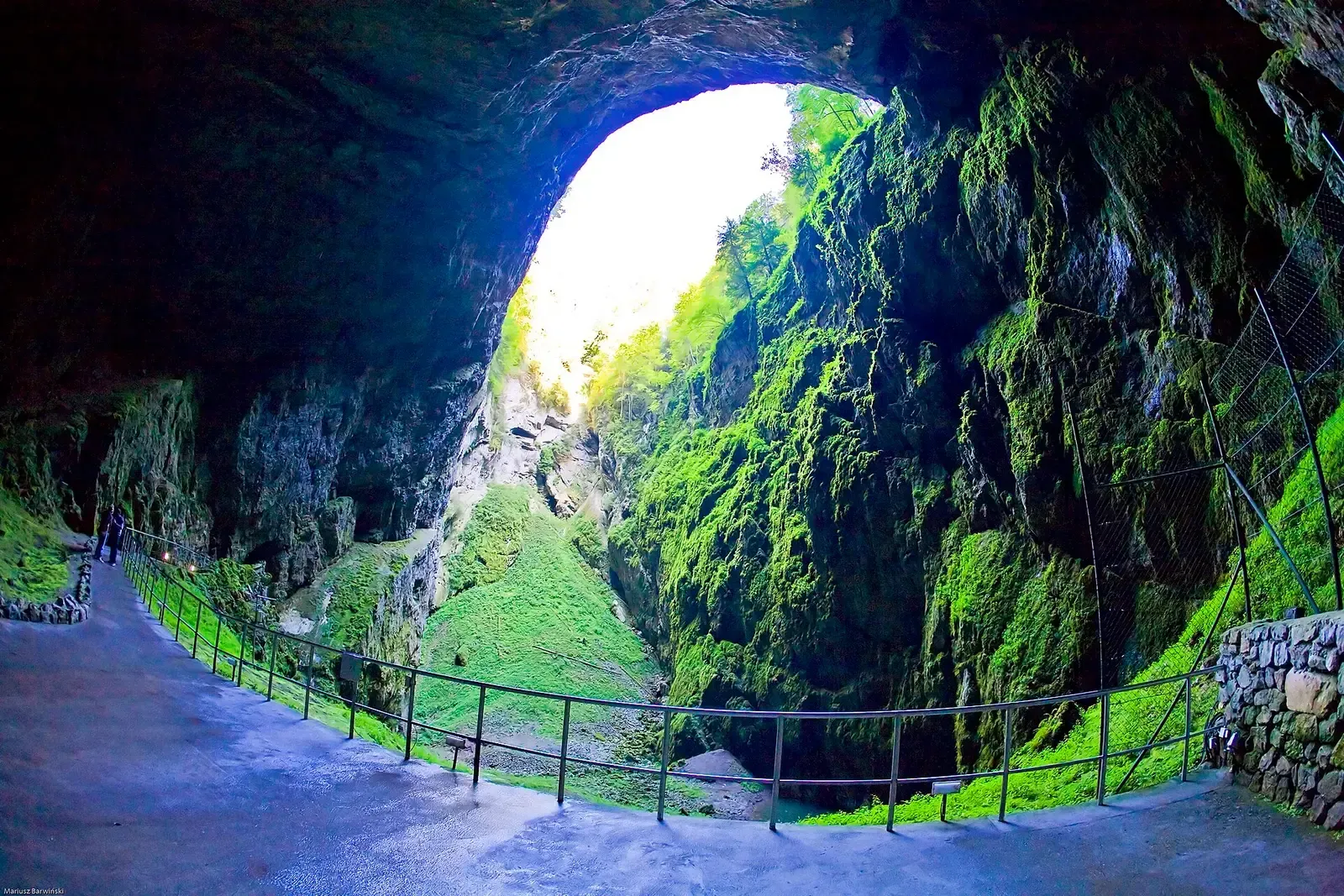
The morning air hit hard at the Moravian Karst rim, a cold jab to the lungs. My fingers went numb on the Upper Bridge's metal railing. Fine limestone dust already felt gritty on my palms. Below, the ground simply dropped 138 meters, a black-green hole. It felt like the earth had swallowed itself.
I left Brno's train station an hour before, trading city clatter for Blansko's heavy quiet. My destination: the Macocha Abyss. Moravian farmers, for generations, called it "The Stepmother." I hadn't come for a postcard view. I wanted to understand this place, a wound in the earth that shaped local stories for centuries.
The Stepmother's Story
I peered over the edge. An old man, František, came up beside me. His voice rasped, dry as the limestone itself. He skipped a greeting. He gave a warning. He spoke of the 17th-century tragedy that gave the abyss its name: a desperate woman, her terrified stepson, a terrible decision. "The boy caught the branches of a stunted pine," František whispered, pointing into the drop. "The woman fell clear. They say her malice still hangs in the air down there."
The story felt less like folklore than fact. It feels built into the Moravian Karst. The wind in the gorge didn't just move air; it carried the legend. The abyss isn't just a pit. It's a place that lays bare human limits. A monk, Lazarus Schopper, made the first recorded descent in 1723. He used hemp ropes and a kind of faith few carry today.
Absolon's War Underground
My hike led away from the rim, down towards the Punkevní Caves. Plaques along the trail named Karel Absolon. In the early 20th century, this man spent his life battling the underground Punkva River. He wasn't just mapping tunnels. He fought the earth itself: rising tides, absolute dark, and mud that threatened to swallow him whole. All of it to reveal what lay beneath "The Stepmother."
The path steepened. I thought of Absolon's struggle. Mapping this limestone maze meant working where time moved only by the slow drip of water. This wasn't a cave carved by surface streams. It was a "light-hole" sinkhole. A cavern ceiling simply grew too heavy, then crashed down, exposing Moravia's hidden waterways to the sky. Absolon's efforts let us walk there now, where once only darkness existed.
A Bone-Deep Cold
Inside the Punkevní Caves, the temperature dropped to 7 degrees Celsius. It hit hard, a sudden shock. One moment, sun warmed my shoulders. The next, damp air wrapped around me. Water dripped, a constant, uneven sound. It was the only sound. We walked through chambers where stalactites named "The Angel" and "The Curtain" hung with a fragile precision, looking like they'd crack if you spoke too loud.
At the abyss floor, a different feeling took hold. Looking up, the walls towered, like the inside of a ruined, moss-covered church. The tunnels' claustrophobia opened into this massive vertical space. Near the Upper Lake's cold water, the silence was absolute. No wind reached here. Only the still, cold breath of the limestone. I felt small. My sense of scale, and time, completely changed. A human life here felt shorter than one drop from a stalactite.
The Punkva River's Secret
The true journey began on the water. We boarded small, electric boats into the flooded cave. The motor hummed, a low thrum that vibrated in my teeth. The ceiling dipped so low once, we had to duck, faces inches from wet, jagged rock. Our guide killed the lights for a second. The dark became absolute. It pressed in, a physical weight.
In that total dark, I thought of the first people who paddled these waters. We passed through the Masaryk Dome. Its beauty felt delicate, almost overwhelming. The stalactites were translucent, catching the boat's lamp like ice. This underground river, the Punkva, spent millennia carving its path through Moravia. It created a world powerful enough to swallow rock, yet fragile enough that a human touch could damage it.
Back in the Light
Stepping out of the cave into the Moravian afternoon hit like a sudden shift. I took the cable car back to the rim. The forest canopy spread below, a vast green blanket. The Moravian Karst is a protected area (CHKO), and the conservation efforts show. Eco-friendly "road trains" and strict group limits are in place. The idea isn't to conquer the abyss anymore. It's to keep it.
I walked the rim trails for a final hour, away from the groups. Near a spring, a fire salamander moved, its yellow and black skin a bright flash against the damp leaves. My view of Macocha had changed. It wasn't just a hole in the ground. It felt like a living thing, with depths we barely understand. The "Stepmother" doesn't swallow us whole. She simply lays bare the true scale of this world.
Jan's Pro-Tip: Macocha
Book your cave entry months ahead. This isn't a polite recommendation; it's a hard requirement. The Punkevní Caves see more visitors than any other cave in the country. They enforce a strict daily cap to protect the Masaryk Dome's humidity. Dress for winter underground, even in July. Most important: walk the rim trails away from the main bridges. The true heart of the Karst isn't found in the gift shop. It's in the quiet places, where you hear the earth under your boots and the deep, still silence.
That day, the Stepmother felt less like a legend and more like a stark, geological truth. Staring into that deep, I understood what it means to truly look at a place, not just pass through it.